Posts

Pancake Ice and Winter

Image
Our training on the James Clark Ross ( click to view a previous blogpost ) introduced us to stoves and Tilley lamps which, at the time, seemed hard to imagine the use for while sailing through the tropics. However, when moving around Antarctica, the utility of devices to keep warm is certainly more relevant and much welcomed. On weekends and bank holidays, it is common for people to skin up to the caboose - a small red refuge hut (a reconverted shipping container) -  ski or snowboard in some fresh snow and warm up with a cuppa. Interestingly, melting a whole pot of snow yields only a minute amount of water, when expressed as a volume, the snow to ice ratio is 10 parts snow to 1 part water. Bearing in mind this is fresh snow and ice is denser and cutting ice blocks yields a greater volume than the equivalent volume of snow. The caboose - at the bottom of 'Vals', a gentle ski slope Snowboarding on Vals An excellent place for a cuppa! Primus stoves and Tilley...
Out With The Field Guides

Image
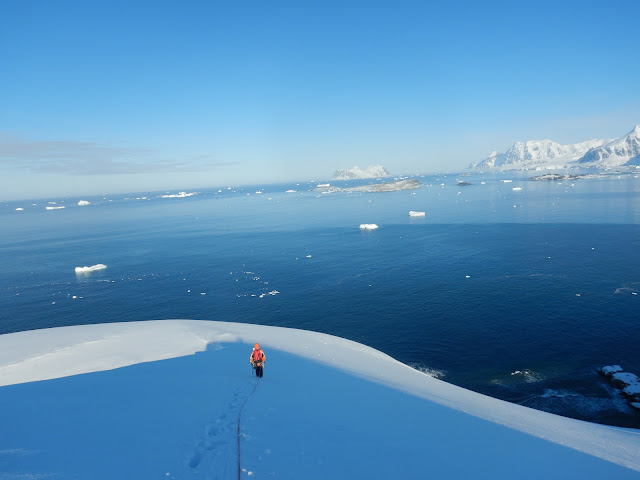
The British Antarctic Survey (BAS) employs several field guides to support operations in the deep field which occur across the busy austral summer. During the period of maximal daylight, from November to February, the station buzzes with scientific projects optimising the long daylight hours. Projects range from geological expeditions and drilling ice cores to maintaining weather stations and installing antennas (find out more here about  ice chemistry  and  geological research ). The transition from a busy summer season to the quiet winter is marked by the departure of the final plane and cargo vessel - this concludes the summer season. Only twenty-three personnel remain on station, isolated for eight months of winter. Four field guides remain as part of our core wintering team. The wintering team conducts various training modules with the field guides in order to prepare for Antarctic conditions. The British Antarctic Survey consider this as essential tra...

Diving & Marine Life

Image
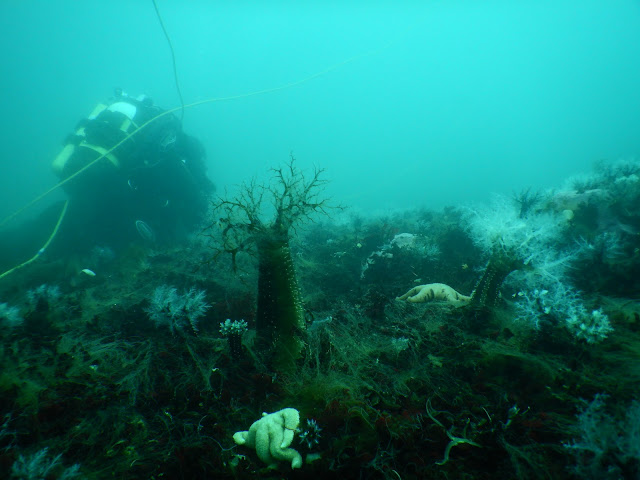
I first experienced the marine team as a group of eight people comprising two of each of the following positions: boating officer, diving officer, marine assistant and marine biologist. Across two short months the old wintering team and the new wintering team handed over to each other. For the new incoming team we had to learn how best to conduct complex polar diving operations in a very short amount of time. The days flew by, as we were tasked with continuing existing science projects whilst pursuing new ones.                Exploring the local dive sites with the outgoing Marine Biologist, Joe Marlow. Our offices are spread across diverse locations: at the southern end of the station in the  Bonner Laboratory , in the boat shed and, of course in the Southern  Ocean! Typically we start our day with a morning boat briefing  at 08:30 where we discuss the weather trends for the day  (wind speeds, wind dir...